
Business Valuation Methods: The Income, Market, and Asset Approaches Explained

How is a business valued? The answer depends on what the business owns, what itis expected to earn, and what buyers have paid for comparable businesses.
Valuation professionals organize business valuation methods into three broad approaches:
- Income approach: Estimates value from the financial benefits the business is expected to generate.
- Market approach: Uses prices paid for comparable businesses or interests in businesses.
- Asset approach: Evaluates the company’s assets and liabilities.
Each approach can contain more than one method. A valuation professional considers the approaches that are relevant to the company and its purpose, selects methods supported by the available information, and reconciles the results into a conclusion of value.
The approaches do not always produce the same number. They rely on different evidence and may answer slightly different questions until their assumptions are made consistent.
This guide explains how the three valuation approaches work, when each may be useful, and why selecting a method requires more than choosing a formula.
What Is the Difference Between a Valuation Approach and a Valuation Method?
A valuation approach is a broad way of looking at value. A valuation method is a specific calculation within that approach.
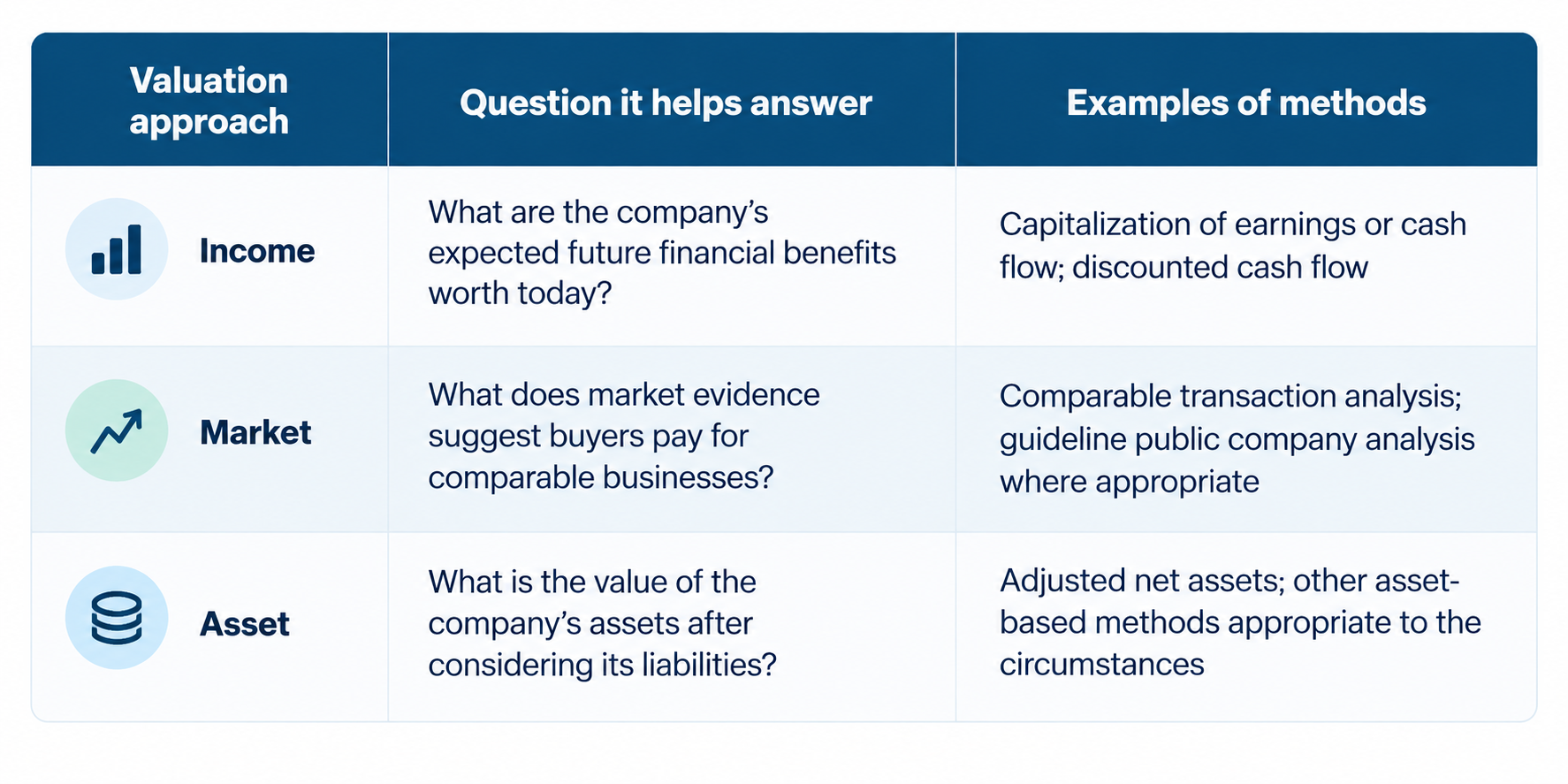
Terms such as EBITDA, seller’s discretionary earnings (SDE), revenue, and cashflow describe financial measures. They are not separate valuation approaches.
For example, an appraiser might use normalized EBITDA in a market method that applies a multiple derived from business sales. The same company’s expected cashflow might inform an income method. The choice of financial measure must fit the method and the evidence being used.
What Does a Business Valuation Need to Define First?
Before selecting business appraisal methods, the analyst needs to establish what is being valued.
A valuation may concern the entire operating business, the equity held by its owners, or a particular ownership interest. It may be prepared for a potential sale, financing, succession planning, an ownership dispute, gift or estate tax reporting, or another purpose.
The analysis also needs a valuation date. Information available or reasonably knowable as of that date may differ from information that becomes available later.
Other questions affect the methods and their application:
- What standard of value applies to the engagement?
- Is the company expected to continue operating?
- Does the interest being valued convey control?
- Which assets and liabilities are part of the business being valued?
- How involved is the owner in daily operations?
- Are the historical financial results representative of the future?
For example, a company with valuable real estate requires careful treatment if the property will be retained by the owner rather than included in a sale of the operating business. The appraiser may need to evaluate the property separately and reflect appropriate rent in the operating company’s earnings.
Defining the subject of the valuation comes before applying a multiple or projecting cash flow.
The Income Approach: Value Based on Expected Financial Benefits
The income approach estimates what the company’s expected future economic benefits are worth as of the valuation date.
A buyer generally cares about what the business can produce in the future. Historical results help inform that expectation, but past earnings alone are not the value of the company.
The financial benefit used in an income method may be earnings, cash flow, or another defined measure. It must be consistent with the rate used to convert those benefits into value and with whether the analysis is valuing the operating business or equity.
Two common income methods are capitalization and discounted future benefits.
Capitalization of Earnings or Cash Flow
A capitalization method converts a representative annual financial benefit into a value indication. In simplified form:
Indicated value = Representative annual benefit ÷ Capitalization rate
Suppose an analysis supports a representative annual benefit of $300,000 and a capitalization rate of 20%. The illustrative calculation is:
$300,000 ÷ 20% = $1,500,000
The example shows the mechanics, not an appropriate rate for any particular company.
The analyst must determine whether the $300,000 is a reasonable measure of expected ongoing performance. The capitalization rate must reflect the risk and expected growth associated with that same benefit stream. A rate for equity cashflow, for example, should not be applied to a differently defined company-wide earnings figure.
Capitalization can be useful when earnings have reached a reasonably stable level and a single representative benefit can adequately reflect expected future performance. A company does not need identical earnings every year, but significant expected changes may call for a more detailed forecast.
Discounted Cash Flow
A discounted cash flow method, often called a DCF, separately estimates financial benefits over a forecast period and converts them to their value as of the valuation date. It also considers value beyond that forecast period.
A DCF may be particularly useful when the business is expected to change materially. Examples include:
- A new location that is still ramping up
- A planned expansion with significant near-term investment
- A major contract beginning or ending
- A temporary decline followed by a supported recovery
- A change in margins or staffing
- A business moving from development toward stable operations
The forecast should reflect the costs and investment needed to produce the projected results. Higher revenue does not necessarily mean higher cash flow if the company must also hire employees, purchase equipment, or fund additional receivables and inventory.
The discount rate reflects the risk associated with receiving the forecast benefits. More uncertain forecasts generally require closer examination of both the projections and the associated risk.
A DCF can be detailed, but detail alone does not make a forecast reliable. The assumptions must be supportable in light of the company’s history, operating capacity, industry conditions, and information available as of the valuation date.
Strengths and Limitations of the Income Approach
The income approach directly considers the company’s ability to produce future benefits. It can account for growth, decline, and changes that historical results do not fully capture.
Its conclusion also depends heavily on its inputs. Small changes in projected earnings, cash needs, growth, or risk can materially affect the result. A valuation professional should explain the significant assumptions and evaluate whether they fit the company’s circumstances.
The Market Approach: Value Informed by Transactions
The market approach looks to evidence from transactions involving other businesses or ownership interests. Its central question is: What do the available transactions suggest buyers paid for comparable financial benefits?
A common private company method uses transaction data to calculate a multiple:
Transaction multiple = Relevant transaction price ÷ Financial measure
The financial measure might be SDE, EBITDA, or revenue. An appraiser then applies an appropriately selected multiple to the subject company’s corresponding measure.
Suppose a relevant transaction reports a price of $1,200,000 and SDE of $400,000.Its observed multiple is:
$1,200,000 ÷ $400,000 = 3.0 times SDE
That transaction alone does not establish that another business should be valued at 3.0 times SDE. Its price, earnings, business characteristics, and transaction terms need to be understood.
How Are Comparable Transactions Reviewed?
Transaction databases may provide searchable information such as industry classification, business description, revenue, earnings, transaction date, geographic location, sale price, and reported deal structure. The detail varies from one transaction to another.
An appraiser can use that information to identify potentially relevant sales and evaluate their financial comparability. A shared industry code is not enough; two companies in the same industry can have very different operations, scale, and profitability.
Many important characteristics of the subject company cannot be screened reliably as transaction database criteria. These include customer concentration, owner involvement, management depth, recurring revenue, and capital requirements. The analyst considers those characteristics when interpreting the market evidence and assessing the subject company’s earnings and risk.
Transaction data also has limitations. The reported financial information may be incomplete, and the database may not fully explain what was included in the price. The appraiser must consider whether the buyer acquired assets or equity and how items such as inventory, working capital, cash, and debt were treated.
Why Must the Multiple Match the Earnings Measure?
SDE and EBITDA are defined differently.
At its most basic level:
SDE = EBITDA + One owner’s compensation
SDE commonly describes the benefit available before compensating one owner-operator. When multiple owners work in a business, the compensation of the other working owners remains in salary expense for the SDE calculation. This is consistent with SDE transaction multiples that reflect the benefit available to one owner-operator.
EBITDA generally retains compensation for the management needed to operate the company, subject to appropriate normalization.
An SDE multiple should therefore be applied to consistently calculated SDE. An EBITDA multiple should be applied to consistently calculated EBITDA. Selecting whichever combination produces the highest number would create a mismatch between the transaction evidence and the company being valued.
Strengths and Limitations of the Market Approach
The market approach brings actual transaction evidence into the analysis. It can provide a useful comparison with an income-based result.
Its usefulness depends on the availability, quality, and relevance of the data. Private business transactions are not perfectly alike, and their reported details may be limited. The analyst must interpret the evidence rather than treat a database average as the company’s value.
For more detail on how multiples are calculated and applied, see “Small Business Valuation Formula: How Business Valuation Multiples Are Calculated.”
The Asset Approach: Value Based on Assets and Liabilities
The asset approach evaluates a company through what it owns and what it owes.
One method is the adjusted net assets method. The analyst examines the assets and liabilities and makes appropriate adjustments to reflect the value premise and the assets’ and liabilities’ economic values, rather than assuming their recorded book amounts equal value.
In simplified form:
Adjusted net asset value = Adjusted value of assets − Adjusted value of liabilities
Assume a company has assets recorded at $2 million and liabilities of $800,000. Its accounting book equity is $1.2 million. That is an arithmetic starting point, not necessarily the company’s value. Equipment, real estate, inventory, receivables, unrecorded assets, or liabilities may require analysis.
When Is the Asset Approach Particularly Relevant?
The asset approach may receive significant weight for:
- A holding or investment company
- A company whose value is primarily tied to its assets
- A business with substantial real estate or other non-operating assets
- A company with limited prospects for generating returns beyond its net asset value
- A company facing a potential winding down, depending on the valuation premise
The company’s circumstances determine how the assets should be considered. Assets used together in a continuing operation may have a different valuation context from assets sold separately in a liquidation.
Why Isn’t Book Value Automatically Business Value?
Accounting balances often reflect historical cost and accounting rules. They may not equal current economic value.
A property purchased years ago could have a current value that differs substantially from its book amount. Accounts receivable may include amounts that will not be collected. Inventory may contain obsolete items. Some valuable intangible assets may not appear separately on the balance sheet.
Book value can be relevant information, but subtracting recorded liabilities from recorded assets does not automatically answer what the business is worth.
Can an Asset-Heavy Business Also Have Operating Value?
Yes. A manufacturer, for example, may own significant equipment and also have customer relationships, an established workforce, systems, and earning capacity.
An appraiser should consider the relationship between the company’s assets and the earnings those assets produce. Adding all operating equipment to a value already derived from the business’s earnings can double count it. Excess or non-operating assets may warrant separate consideration.
The asset approach should be applied to the actual company and valuation purpose, not used as an automatic add-on to an income or market result.
How Do the Three Approaches Compare?
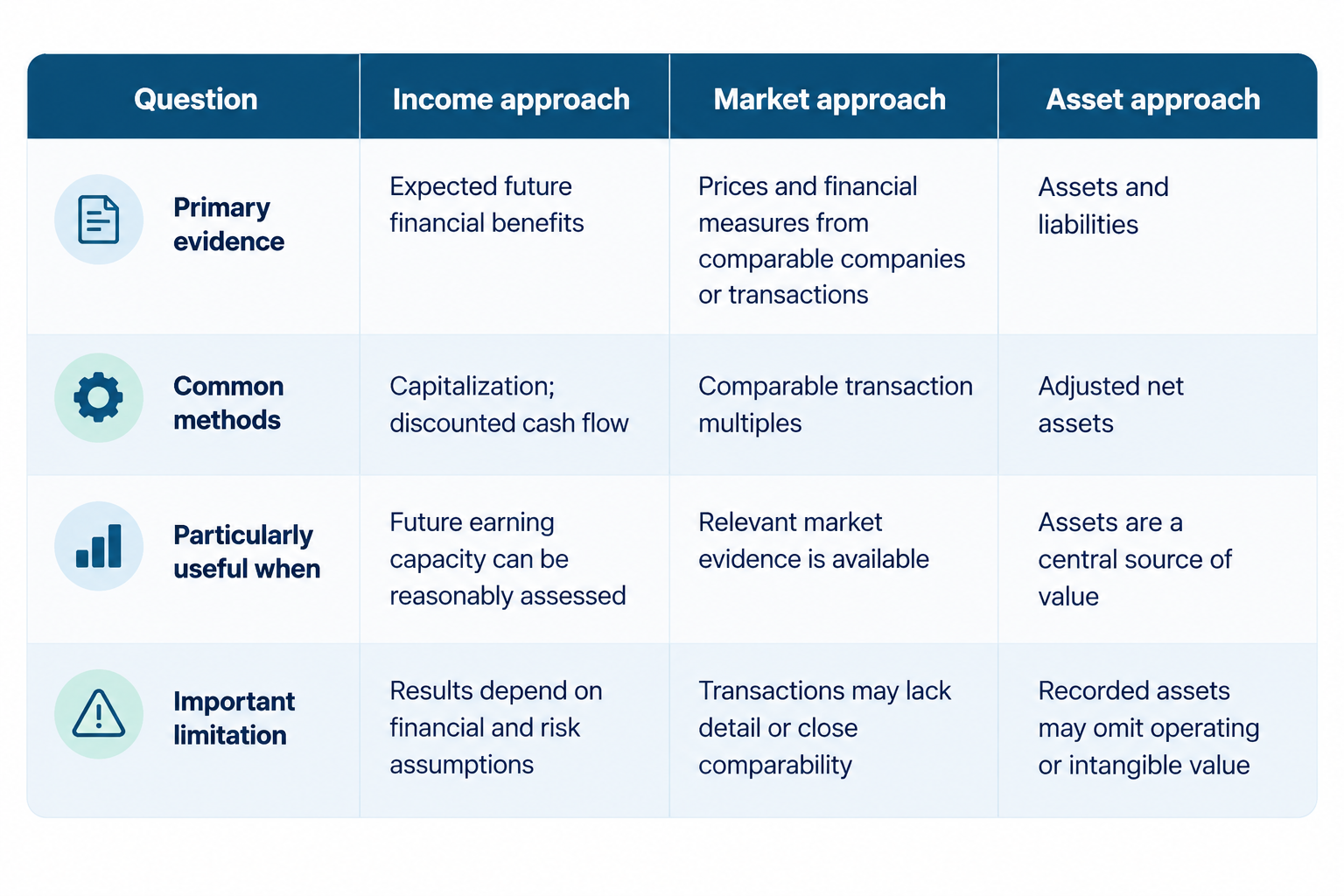
The table is a guide to what each approach examines. It does not establish a rule that a particular type of business must always be valued with one approach.
How Does Financial Normalization Affect the Methods?
Financial statements and tax returns are essential inputs, but reported earnings may not represent ongoing operating performance.
Financial normalization evaluates proposed adjustments such as:
- Owner compensation above or below a reasonable amount
- Personal expenses paid by the business
- Related-party rent above or below market
- Non-operating income and expenses
- Unusual gains or losses
- Costs that are expected to continue despite being described as “one-time”
Normalization may increase or decrease earnings. For example, removing a supported nonbusiness expense could increase normalized earnings. Recognizing reasonable compensation for work the owner performs without pay could decrease them.
These decisions affect an income method’s representative earnings or projections and a market method’s earnings measure. They also help the analyst distinguish operating assets and liabilities from non-operating items.
A proposed adjustment should be supported and applied consistently. Removing thecost of a function while assuming the business retains the benefit of that functioncould overstate value.
How Does the Appraiser Decide Which Methods to Use?
A valuation professional considers each approach’s relevance in light of the company and available evidence.
Questions may include:
- Does the business have a history of sustainable earnings?
- Are significant changes expected after the valuation date?
- Can management’s projections be reasonably evaluated?
- Is there useful transaction data for comparable businesses?
- Does the business own assets unrelated to operations?
- Is the company expected to continue operating?
- What is the valuation’s purpose and what ownership interest is being valued?
A stable operating company may support a capitalization method and a comparison with relevant business sales. A company expecting material changes may be better explained by a detailed forecast. An asset-holding entity may place greater emphasis on adjusted net assets.
These are examples, not fixed rules. The appraiser’s task is to select and explain methods that fit the facts.
Considering all three approaches does not mean each must produce a usable result or receive equal weight. If market transactions lack enough information for a meaningful comparison, an appraiser may decide not to rely on that method. If an asset method does not capture the earning capacity of an established operating business, its result may have limited weight.
What Does It Mean to Reconcile Valuation Results?
Different methods can produce different indications of value. Reconciliation is the process of evaluating those indications and reaching a conclusion.
It is not necessarily a simple average.
Suppose an income method produces an indication of $2.0 million and a market method produces $2.4 million. The analyst should examine why they differ. The market data may reflect businesses with higher growth, or the subject company’s projected earnings may be conservative. Alternatively, the transactions may include assets that were treated separately in the income method.
The analyst should first check that the methods are measuring value on consistent terms. Then the analyst considers the strength of the evidence and the assumptions supporting each result.
A method based on strong company-specific financial information may receive more weight than a method based on sparse transaction data. In another case, relevant transactions may provide an important check on uncertain projections. The reasoning should be explained rather than hidden inside an unexplained average.
Why Do Enterprise Value and Equity Value Matter?
Valuation methods must be applied consistently with the type of value being calculated.
Enterprise value generally refers to the value of the operating business before considering how it is financed. Equity value refers to the value attributable to its owners after the appropriate treatment of debt and other balance sheet items.
When a method produces enterprise value, a simplified bridge may be:
Equity value = Enterprise value − Interest-bearing debt + Excess cash ± Otherappropriate non-operating items
The actual calculation depends on the company and the method used.
Operating assets needed to generate the earnings are generally reflected in the value of the business that uses them. Equipment should be considered separately only when it is excess or non-operating. Inventory may need separate treatment if the comparable transaction prices used in a market method excluded it. Normal operating working capital should not be added again if the method already assumes it is included.
Neither enterprise value nor equity value necessarily equals an owner’s net proceeds from a sale. Taxes, transaction expenses, working capital adjustments, financing, earnouts, and other negotiated terms can affect the amount received.
Does the Best Method Change With the Purpose of the Valuation?
The purpose affects the questions the appraisal must answer and the information the analyst must examine.
An owner exploring a possible sale may want to understand the business’s current value and the financial factors a buyer might examine. An ownership dispute may require analysis of a specific interest and governing agreements. A gift or estate tax valuation may involve a partial ownership interest and additional considerations. A lender may have requirements about the report and the party ordering it.
The recognized valuation approaches remain the same, but the appropriate methods, assumptions, scope, and report may differ. A planning estimate should not automatically be used for a legal, tax, or disputed ownership matter.
Common Mistakes When Comparing Business Valuation Methods
Calling SDE or EBITDA a Valuation Approach
SDE and EBITDA are earnings measures. They may be used within a valuation method, but they are not substitutes for the income, market, or asset approaches.
Assuming the Asset Approach Means Book Value
Recorded asset balances can differ from current economic values. The treatment of assets and liabilities also depends on the valuation premise and what is being valued.
Treating a Market Multiple as Universal
A multiple from another transaction must be interpreted in light of its earnings definition, sale price, included assets, and relevance to the subject company.
Treating EBITDA as Cash Flow
EBITDA does not automatically account for taxes, capital expenditures, working capital changes, or debt principal payments.
Adding Operating Assets to an Earnings-Based Value
Operating assets needed to produce earnings are generally reflected in a value developed from those earnings. Adding them again can double count their value.
Averaging Method Results Without Explanation
When methods disagree, the analyst should investigate the reasons and weigh the quality of the evidence. An automatic average does not resolve inconsistent assumptions.
Frequently Asked Questions
What are the three main business valuation approaches?
The three main approaches are the income approach, which considers expected future financial benefits; the market approach, which considers comparable market evidence; and the asset approach, which considers assets and liabilities.
What is the most accurate business valuation method?
No method is universally most accurate. Reliability depends on the company, the purpose of the valuation, the available information, and how well the method’s assumptions fit the facts.
Is a multiple of earnings an income method?
A multiple derived from comparable business sales is generally used within the market approach. Income methods convert expected future financial benefits into present value using a rate consistent with the benefit stream.
Can an appraiser use more than one method?
Yes. An appraiser may develop indications under multiple relevant methods and reconcile them. Each method should add useful evidence; using more methods does not automatically improve the conclusion.
Can a profitable business be worth more than its net assets?
Yes. An operating business may generate value from its customer relationships, workforce, systems, reputation, and expected earnings beyond the value indicated by its net assets alone.
Does a company with losses have to be valued using the asset approach?
No. The analyst should consider why losses occurred and whether the company is expected to recover. An income or market method may still be relevant if its assumptions can be supported.
Is a business valuation the same as a sale price?
No. A valuation estimates value under defined assumptions and as of a particular date. An actual transaction also reflects buyer and seller negotiations, due diligence, financing, assets and liabilities transferred, and other terms.
Bringing It All Together
The income, market, and asset approaches provide three ways to examine a business’s value. The income approach focuses on expected financial benefits. The market approach considers what buyers paid in relevant transactions. The asset approach examines the company’s assets and liabilities.
The appropriate business valuation methods depend on the company, the interest being valued, the valuation date and purpose, and the evidence available. A credible analysis defines those matters first, makes appropriate financial adjustments, applies the selected methods consistently, and explains how their results support the conclusion.
At BizWorth, our appraisers consider all three approaches and select the methods appropriate to each engagement. We review financial records, learn how the business operates, evaluate proposed adjustments, and examine the evidence behind the resulting value indications. That process helps owners and advisors understand both what the business may be worth and why.
